
A CNFans bill, layer by layer
No invented figures here: the parts of the bill, which of them the archived CNFans pages mentioned, and how yuan prices turn into your currency.
Layers of a link-based bill
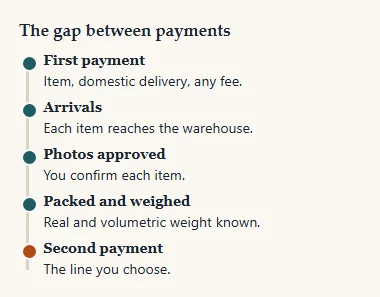
What you actually pay for a link-based order comes in layers. The first payment covers what the seller asks for your chosen option and its delivery to the warehouse inside China, plus any service fee the agent charges. The second payment, after your items have arrived and been weighed, covers the international line and any packing extras you asked for.
A third cost sits outside the agent: duties or taxes your own country may charge when the parcel arrives. Those follow your country's rules and are paid to the carrier or the customs authority, not to CNFans.
Each part is set by someone different: the seller sets the first two, the agent its own charges and its line prices, and your government the duties. Knowing who sets a number tells you who to ask when it surprises you.
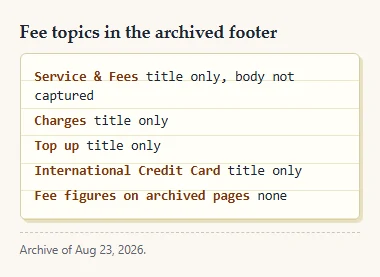
Fee figures in the August snapshot: none
Very little. Our archive holds just two CNFans pages from August 23, 2026, its home and its registration form, and neither shows a fee figure of any kind. Footer topics were titled Charges, Service and Fees, International Credit Card and Top up, yet the articles behind those names were never captured, and today they resolve to the maintenance notice.
We are not going to fill that gap with guesses. Until the shop reopens and its fee pages can be read, the honest position is that CNFans' own charges are unknown to us. If you need them now, the support address on the notice is the only place to ask.
When the shop returns, its fee pages are the first thing we will read, and any figure we can confirm will appear here with the date we saw it.
Prices in yuan, payment in your currency
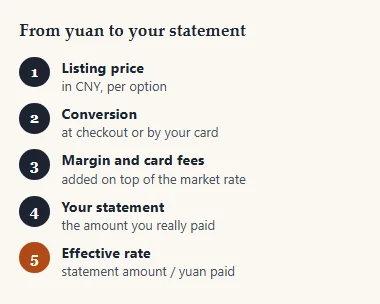
Listings price everything in yuan (CNY). Somewhere between the listing and your statement, those yuan become dollars, pounds or euros, either at the agent's checkout or at your card issuer. The exchange rate used there is rarely the mid-market rate quoted in the news; a margin or a foreign transaction fee usually sits on top.
You can measure your own rate after the fact. Divide the amount on your statement by the yuan total you paid, and you have the effective rate for that order, fees included. Do it once and you will know how much to add to any yuan price you see in the catalog.
Card statements sometimes show the conversion on a separate line from the foreign transaction fee. Add them together before dividing, or the rate you work out will look better than it was.
Where option choices change the price
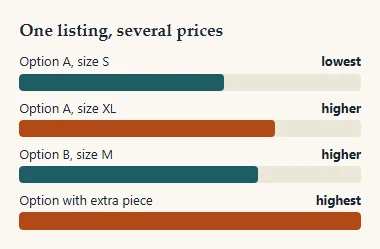
A catalog card shows one price, but a listing can price each option separately. Larger sizes, certain colors or a bundle with an extra piece often cost more than the figure on the card, which is commonly the cheapest option on offer.
Select your exact option on the listing before you write the price down, and write it next to the option name. That pairing is also what you check later if the agent reports a price difference.
If the agent later reports that the price is higher than you expected, the first question is whether it bought the option you noted. Most price surprises turn out to be option mix-ups rather than price rises.
Paying twice, weeks apart
Because shipping is priced on the packed weight, you cannot know the second payment when you make the first. Items arrive at different times, the warehouse photographs them, and only when the last one is in can a parcel be packed, weighed and quoted.
Budget for that gap. The exchange rate may move between the two payments, and a bulky jacket can make the second payment larger than the first. If the total matters, keep a rough shipping allowance in mind before you add another link.
A practical habit is to decide your shipping budget at the start and treat it as part of each item's cost. It keeps the second payment from feeling like a penalty.
A cost record for each link
Keep one line per link: item number, option, yuan price, the seller's domestic delivery if listed, and the date. When the parcel is weighed, add each item's rough share of the shipping. The record takes a minute and answers two questions later: what did this item really cost, and was the price the agent charged the one the listing showed.
Done for a few orders, these records also show you something no guide can: your own typical cost on top of the listing price, based on the lines you choose and the rate your card gives you.
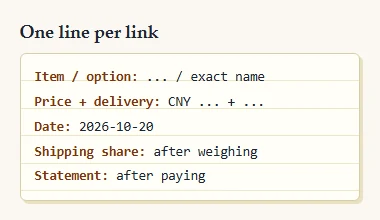
Put the selected option, not the URL, in the cost record
An invented listing offers options at CNY 80, CNY 120 and CNY 165. All share one item number. If you chose the CNY 165 option and domestic delivery is CNY 8, the purchase subtotal starts at CNY 173, not the CNY 80 headline shown on a catalogue card.
Save the item number, selected option, subtotal and converted payment-screen total together. Add separately stated service or payment charges only once. When a seller changes the price, ask for the revised option total before authorising the purchase; a valid link does not lock a price.
If an option is unavailable, decide whether to wait, choose another option or request cancellation. Ask what has been charged and which part can be reversed. Keep the purchase record separate from the later international parcel quote so a refund for one item is not confused with a shipping adjustment.