Item numbers and the wrapping around them
Why a run of digits decides what you buy, which parts of a link you can safely drop, and the mistakes that load without an error.
The ten digits that pick the product
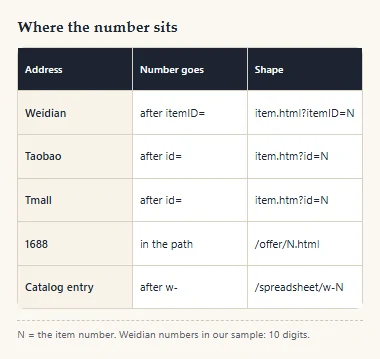
Every marketplace link has a slot for the item number, and each platform puts it somewhere predictable. Weidian writes it after itemID=, Taobao and Tmall after id=, 1688 inside the path as /offer/ followed by the number and .html. Catalog entries here end in w- and the same number as the Weidian listing.
We sampled this on October 20, 2026: 1,091 entries pulled from sixteen categories all carried the w- prefix and a ten-digit number, and on 32 entries opened in full, the number in the entry address and the number in the outbound Weidian link were identical. Whatever else a link carries, those digits are what the seller, the agent and the warehouse use to know which product you mean.
Platforms differ, but the rule does not: find the key, take the digits after it, and the rest of the address can be rebuilt around them. The link reader applies exactly that rule.
Invite codes, tokens and tags on a link
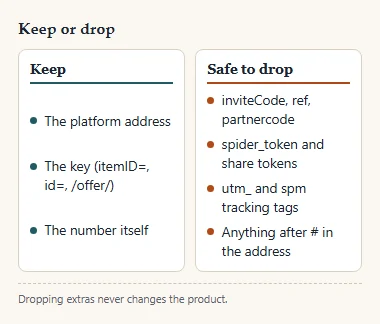
The longer of the two Weidian links on our sampled catalog entries added an inviteCode and a spider_token after the number. Links copied from apps tend to collect tracking tags, and links from agents carry their own referral codes. None of these change which product the link opens.
You can usually leave them in without harm, but there are two reasons to drop them. A short, plain link is easy to check by eye, so a wrong digit stands out. And a referral code credits whoever made the link, which is worth knowing before you pass it on. In fairness, our own catalog links carry tracking tags too; about explains them.
There is one extra worth noticing rather than deleting: anything after a # sign. On some sites it moves the page to a section or opens a tab, and it never holds the item number on the platforms covered here.
One number, nineteen ways to write an order address
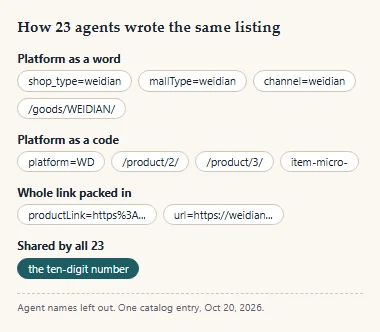
Agents build their own order-page addresses around a listing, and they do not agree on a format. The jacket entry we read on October 20, 2026 listed 23 agents' order addresses. With invite codes masked, 19 distinct shapes remained. The platform was named in eight different ways, from shop_type=weidian to a bare digit in the path, and five addresses carried the entire Weidian link, URL-encoded, inside their own.
What they all shared was the ten-digit number, present in every one of the 23. That is the practical takeaway: when an agent address is all you have, look for the long run of digits, and pair it with the platform. The link reader does both and unpacks packed links first.
This also explains why an agent address copied from a forum can look broken even when it is fine. It is a wrapper you did not make, around a number you can still use.
One wrong digit opens someone else's listing
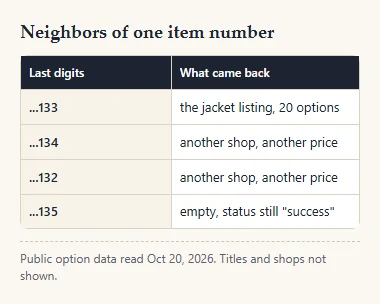
Item numbers sit close together, so the numbers around yours are rarely empty; they tend to belong to other sellers. On October 20, 2026 we took the jacket listing's number and changed only the last digit. Down by one and up by one, Weidian's public option data returned two unrelated listings from a different shop, with prices of their own. Up by two returned nothing at all, yet the response still said success.
A typo therefore does not fail loudly. It quietly becomes a valid order for another product. Copy numbers, never retype them, and after pasting a link, look at the first photo before doing anything else.
The same applies in the other direction: if a seller or an agent quotes an item number back to you, compare all ten digits with your note, not only the first few.
Short links and app share text
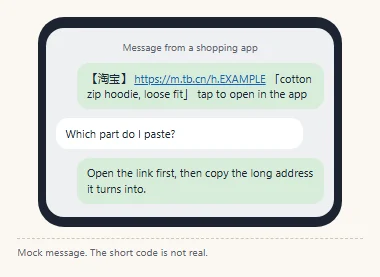
Tap share in a marketplace app and you usually get a message, not a clean address: a bracketed platform name, a short link, the listing title in quotes and an instruction to open the app. The short link points to a redirect, so the item number is not visible anywhere in the message.
Open the short link in a browser and copy the full address it lands on; that one has the number. If you paste a share message into the link reader, it picks the address out of the words and tells you when that address is a short link that still needs opening.
Some apps also put a code in the message that only their own app can read. It is useless in a browser and on an agent's order form; skip it and work from the address.
A page that loads is not proof the listing exists
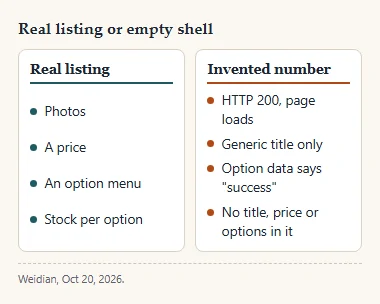
We also asked Weidian for a listing number we made up. The listing address came back with a normal 200 status and the generic page title it uses for any item. Weidian's public option data for the same number reported success and returned an empty record: no title, no price, no options.
So judge a link by its content, not by whether it opens. A real listing shows photos, a price and an option menu. If any of the three is missing, the number is wrong, the listing has gone, or you are looking at a shop page instead of an item.
An empty page from a mistyped number and a page from a delisted product can look much the same. Either way, go back to where the link came from and copy it again before drawing conclusions.