The CNFans Spreadsheet, explained from the card outward
What the CNFans Spreadsheet is, what each card stands for, and why it is worth a look before you open a Chinese marketplace yourself.
Photo cards, each pointing at one listing
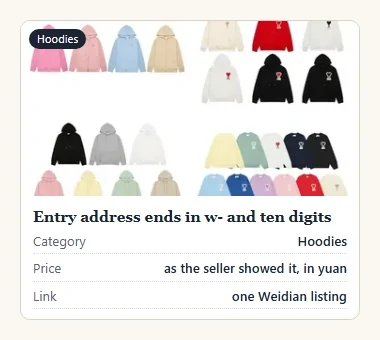
The CNFans Spreadsheet is a product catalog organized by category: outerwear, hoodies, shoes, bags and so on. Every entry is a photo card with the category it sits in, the price the seller showed, and a link to one listing on a Chinese marketplace. It is a shortlist of things somebody has already found, so you can browse in English and arrive at a listing you can order through CNFans.
On October 20, 2026 we pulled 1,091 entries from all sixteen categories. Every one led to a Weidian listing, and every entry address ended in w- followed by a ten-digit number. On the 32 entries we opened in full, that number matched the listing's own item number exactly.
Because every entry we sampled led to Weidian, the catalog is effectively a guide to Weidian listings that suit buying through an agent. That shapes the advice on these pages: when we show where an item number sits, the Weidian format comes first.
Where CNFans fits in
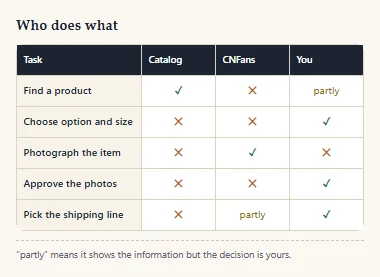
The catalog and the agent do different jobs. The catalog helps you find a listing; CNFans buys from that listing, checks the item in, photographs it and ships it onward to you. Neither replaces the other, and neither decides for you which option or size to order.
That division explains most of what can go wrong. A catalog can show an old price; only the listing has the current one. An agent can buy exactly what you asked for; only you know whether what you asked for was right. The grid alongside shows who handles what.
Keeping the jobs apart also tells you where to send a complaint. A wrong photo on a card is a catalog problem; a wrong item in the warehouse is an agent and seller problem. The help page routes each kind.
Card summary versus live listing
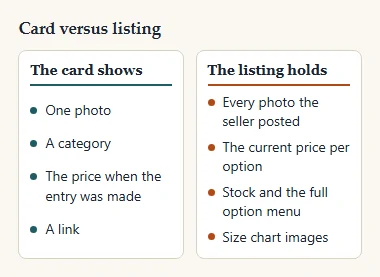
A card is a summary made at one moment. It tells you the product exists, roughly what it looks like and where to find it. The listing holds everything that changes: the price right now, the stock, the full option menu, the size chart, the shop's other items.
The gap can be wide. The jacket card behind our October 20 test showed one photo; the listing behind it offered four styles labeled A to D and five sizes, twenty combinations under a single item number. Only one of the twenty is yours, and the card cannot tell you which.
That is why the guides keep sending you to the listing before anything else. Read a card to decide whether something is worth a closer look, then read the listing to decide what, exactly, you are going to order.
Why start from this catalog
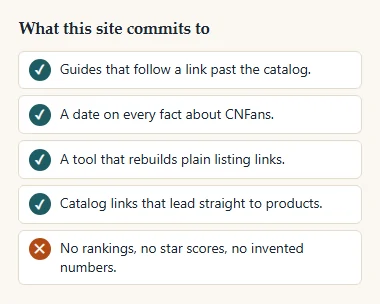
Plenty of places publish lists of product links. What we try to do differently is show the whole relay instead of the first leg only: every guide here follows the link past the catalog, through the order form and the warehouse, to the parcel. The link reader exists for the same reason.
We also date what we claim. Facts about CNFans carry the date we saw them, our own checks say when they were run, and the updates page logs each change. If a list you find elsewhere is fresher for the item you want, use it; the habits on these pages work with any link.
And we say plainly what we cannot see. During the CNFans maintenance, that includes its order form, its warehouse photos and its fees. Where those come up in the guides, you will find the general pattern labeled as such, not a guess dressed up as fact.
How the catalog side stays current
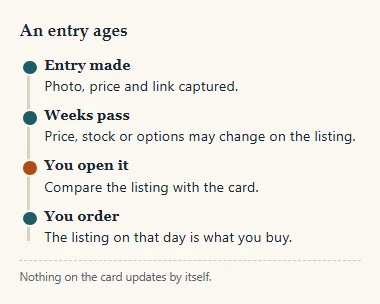
Listings come and go. Sellers raise prices, sell out of a size, rename options or take a listing down, and a catalog entry made last month knows nothing about it. A dead link is not always obvious, either: a Weidian address with a number that matches no listing still loads a page, as we found on October 20.
Treat every entry as a dated lead. Open its listing on the day you order and compare the exact option, price and stock before paying. Keep a copy of the seller record; a catalogue card cannot reserve it.
If you find an entry whose listing has gone, the fastest route is a short email with the entry address. A report with an address can be checked in a minute; a report that says the jacket one is broken usually cannot.
Topics this catalog refuses
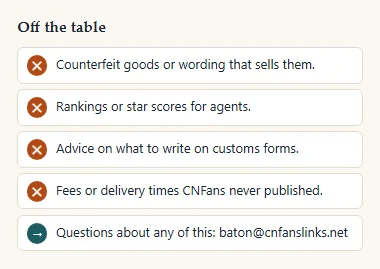
Nothing here promotes counterfeit goods or explains how to get them, and there are no agent rankings or star ratings. Customs paperwork stays yours, with no wording supplied here, and no price, delivery time or fee appears that CNFans has not published.
It is also not CNFans. The catalog and guides are run independently, and catalog links carry tracking tags that can earn us a referral fee. About this site explains how that works and who to contact.
Those limits are not modesty. Each one is a place where a catalog site can mislead, and leaving them out is cheaper for you than reading claims nobody can check.