The parcel leg, from packing table to doorstep
How lines differ, why a bulky parcel can cost more than a heavy one, what combining items does, and what customs means for you.
Line choice starts with the contents
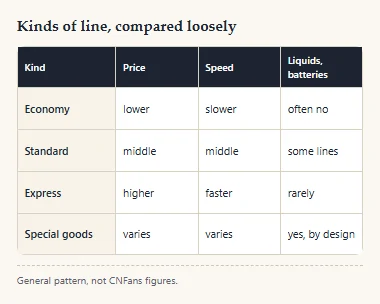
A shipping line is a route and a carrier arrangement the agent offers from its warehouse to your country. Lines differ in three ways that matter: price, speed, and what they accept. Liquids such as fragrance, anything with a battery, magnets and powders are refused by many lines and accepted by a few.
So choose in that order: first rule out lines that will not take your contents, then compare price against how long you can wait. The archived CNFans pages offered a choice of lines and a shipping estimate page, which has never been captured and now shows the notice.
Delivery times quoted for a line are estimates, not promises. Treat the slow end of the range as the realistic one, especially around holidays in China, when sellers and carriers both slow down.
When box size, not the scale, sets the price
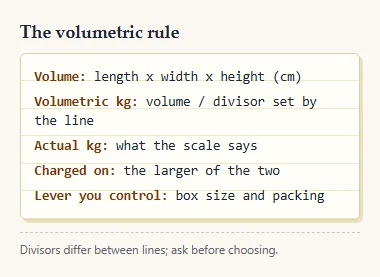
Lines charge on whichever is larger: what the parcel weighs, or its volumetric weight. Volumetric weight turns size into kilograms by multiplying length, width and height and dividing by a number the line sets. A light puffer jacket in a big box can be charged as if it were heavy.
That is why packing matters. Fewer air gaps and smaller boxes bring the volumetric figure down. Ask the warehouse what packing options exist before the parcel is sealed, not after it has been quoted.
Shoes are the classic case. Their boxes add bulk, and whether to keep them is a trade between a smaller parcel and an item that arrives in its original packaging. Decide before packing, because it cannot be undone afterwards.
Putting several links into one parcel
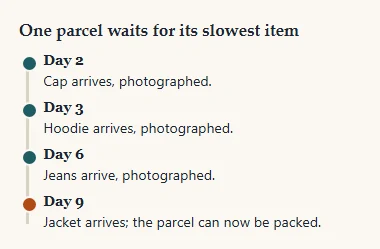
Items from different sellers arrive separately, but they can leave together. Combining them into one parcel, which agents call consolidation, means one weighing and one shipping charge, which usually works out cheaper per item than several small parcels.
The catch is timing. A combined parcel waits for its slowest item, and a single delayed or disputed piece holds up the rest. If one link is stuck, consider shipping without it rather than letting everything sit.
Before waiting for another item, check the current storage allowance, deadline and any extension charge for each arrival. Do not assume a free-storage period from another agent or an older promotion applies.
Your border, your rules
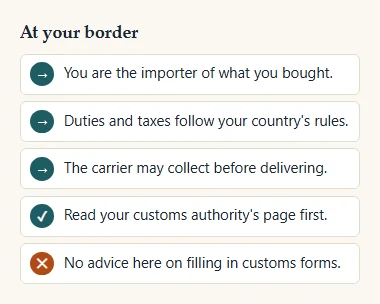
When the parcel reaches your country, you are the importer. Whether duties or taxes apply, and how much, is set by your country's customs rules, and the carrier may ask you to pay before delivery. Nothing here is customs or legal advice, and we do not tell anyone what to write on a customs form.
What we do suggest is reading your own customs authority's page on goods bought from abroad before you order, so the charge at the door is not a surprise, and checking that what you are buying is allowed to be imported where you live.
A good customs authority page answers three things: which goods are restricted, how charges are worked out, and how the carrier collects them. If yours does not, its helpline is the place to ask, not a forum.
Tracking after handover
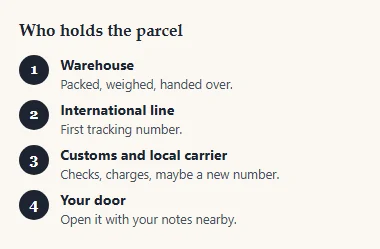
Tracking changes hands along with the parcel. The agent's line produces the first number; once the parcel reaches your country, a local carrier often takes over, sometimes with a fresh tracking number. Long quiet spells between scans are normal around those handovers.
If the tracking stalls well past the line's usual time, ask the agent first, since it booked the line. Keep your carry notes until the parcel is opened; if something arrives wrong, the item numbers are what everyone will ask for.
When you ask about a stalled parcel, quote the tracking number and the line name. Those two details let the agent check with the carrier straight away instead of asking you for them first.