Behind every link: a shop, a product, an option menu
How to read a listing before you order from it, what the option menu tells you, and the slips that turn a good link into the wrong parcel.
What one listing reveals about its shop
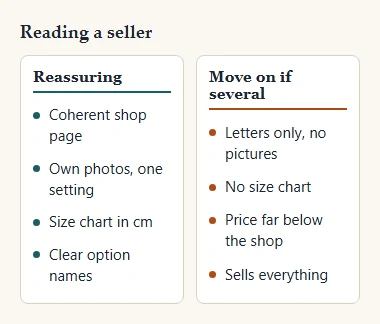
Readable reviews are rare, so judge the seller by the listing and the shop around it. Good signs: a shop page whose other items make sense together, photos taken in the same setting rather than collected from elsewhere, a size chart with centimeters, and option names that say what they are.
Warning signs: options named only with letters and no matching picture, a size chart missing from a clothing listing, a price far below the rest of the shop, or a shop that sells everything from phone cases to coats. None proves a bad seller; together they say move on.
One more sign is easy to check: open two or three other items in the same shop. If they share the same photo setting and the same style of size chart, you are probably looking at a shop that photographs its own stock.
Reading every image before choosing
Knowing how to pick the right product starts with reading the whole listing, not the first photo. Scroll through every image, because sellers put size charts, fabric notes and close-ups in the detail images further down. Then read the option menu end to end and the price for the option you want.
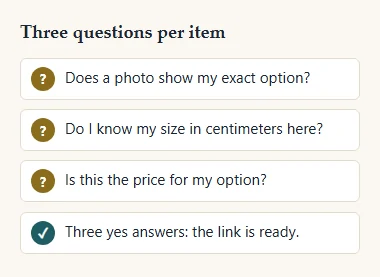
Ask three questions before you commit. Does the photo show the exact option I am choosing? Do I know my size in centimeters for this item? Is the price for my option, not the cheapest one? If any answer is no, the link is not ready yet.
If the listing has a video, watch it. It is the one place where fabric movement, stiffness and true color show up better than in any still photo.
Count the options before you pick one
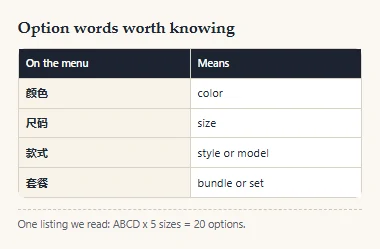
Option menus are where link-based orders most often go wrong, because the link never records your choice. The jacket listing we read on October 20, 2026 had two option groups: one titled ABCD with four styles, one for sizes with five, twenty combinations behind one item number.
Menus are often in Chinese. A few words cover most of them: 颜色 is color, 尺码 is size, 款式 is style, 套餐 is a bundle or set. Copy the option text exactly into your note, characters and all, so it can be matched later.
Watch for options that differ by a single character, such as two colors that share a word. Those are where copying the full text pays off, because a shortened note cannot tell them apart.
A pre-payment pass over the listing
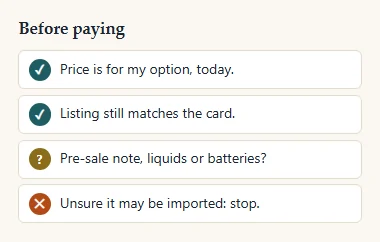
Check that the price you saw is still the price for your option, and that the listing has not changed since the catalog entry was made. Look for a pre-sale note, which means the seller will ship later than usual and your other items may wait for it.
Think about the parcel now, not later. Fragrance, batteries and anything fragile limit your shipping lines. And make sure the item is legal to import where you live; the agent will not decide that for you.
None of these checks needs special tools. They need the listing open, your note beside it, and the patience to read both to the end.
Small slips, wrong parcels
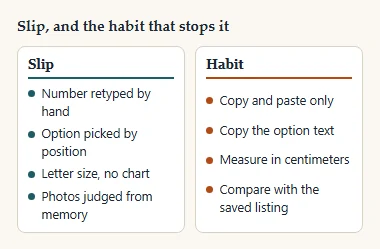
Most bad parcels start with a good link and a small slip. Retyping a number from a screenshot. Choosing an option by its position in the menu rather than its name. Ordering a letter size without a chart. Approving warehouse photos from memory instead of against the listing. Mixing up two look-alike entries.
Each slip has a matching habit, and all of them come down to keeping the number and the exact option name together from the first leg to the last.
The habits feel slow for the first order and become automatic by the third. They also travel well: the same routine works whatever agent you use and whatever platform the listing is on.