Judging a catalog site, and the agent you hand links to
Tests you can run in a few minutes on any product catalog, this one included, and on an agent before your first order.
A ten-minute test for catalog sites, ours too
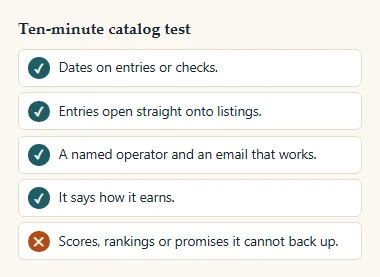
Knowing how to spot a spreadsheet site that earns a bookmark takes a handful of checks. Look for dates: when were the entries made or last checked, and does the site say? Open a few entries and see whether they lead straight to a product listing or detour through sign-up walls and pop-ups. Find out who runs it and how it earns.
Then read how it talks. A site that calls every item perfect, promises results or ranks agents with scores it cannot back up is selling, not guiding. A useful catalog admits what it does not know and tells you where to check. Run these tests on us too; the about page is where we answer them.
No site passes every test perfectly. What separates a useful one is whether it tells you where it falls short, so you know which parts to check yourself.
Dead links and stale prices
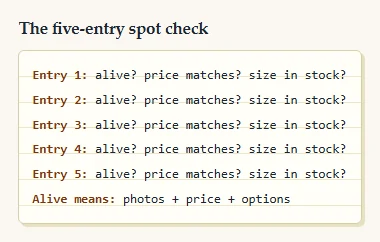
Every catalog decays. Pick five entries at random, open each listing, and note whether it still exists, whether the price matches the card, and whether your size is in stock. One or two misses out of five is ordinary churn; most of them gone means nobody is maintaining the list.
Remember the trap from our own tests: a Weidian address for a number with no listing still loads, so look for photos, a price and an option menu before counting an entry as alive.
Run the same check on this catalog whenever you like. If you find a dead entry, send it in and it will be fixed and logged.
Reading an agent's pages before order one
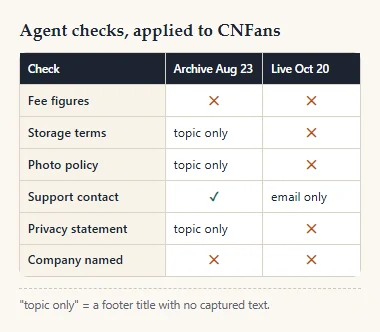
Choosing an agent is mostly reading. Before the first order, look for a fee page with figures, storage terms with a time limit, a description of what the warehouse photographs, a list of lines with what each accepts, a support contact, terms of service, a privacy statement and the name of the company behind it.
Applied to CNFans today, most of that list cannot be checked. The archived pages named help topics but no figures and no company, and the live site shows only the notice. That does not make CNFans untrustworthy; it means the evidence is not available yet, and you should wait for it.
The same checklist applies to any agent you consider. An agent that publishes all of it is not automatically good, but one that publishes none of it gives you nothing to hold it to.
Evidence that outweighs a star average
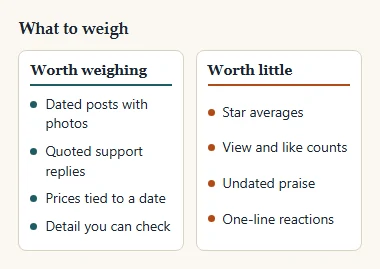
Star ratings and review counts are easy to inflate and impossible to verify from outside. More useful are specifics anyone could check: a dated post with photos of the parcel, a support reply quoted in full, a price that matches the listing on the date given.
Weigh a single detailed report above a hundred one-line reactions, and an old report below a new one. Popularity, whether views, likes or followers, says how far a post travelled, not whether it was right.
Your own records count too. After a few orders, your carry notes and cost records say more about an agent than any thread, because they describe your lines, your items and your rate.